AI as a Trust Engine in the Carbon Market
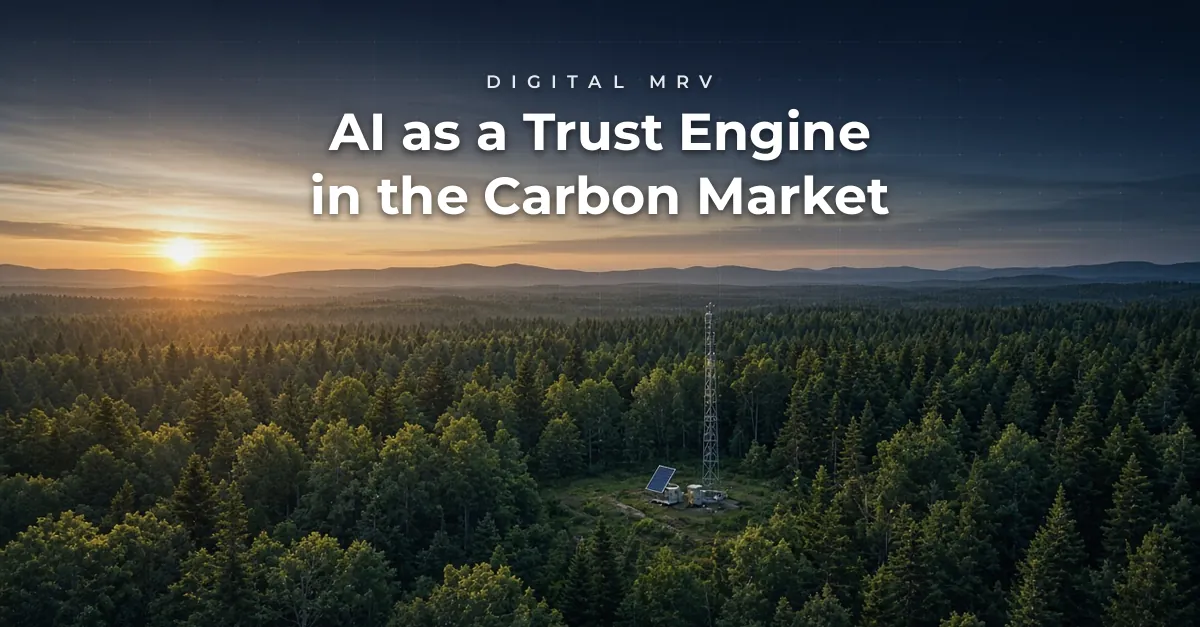
A carbon credit is a claim about the atmosphere. The market is starting to pay more for claims it can trust.
The next question is how we generate that trust — continuously, and at scale. That is where artificial intelligence and digital measurement come in. Used well, they can become a trust engine. Used poorly, they can scale error just as fast as they scale data.
From a yearly snapshot to a living record
Traditional monitoring, reporting, and verification has often been a periodic exercise: field plots, site visits, and a report assembled at the end of a monitoring period.
Digital MRV changes the tempo. Satellites, ground sensors, and automated pipelines can produce a time-stamped record through the life of a project, not only at audit time, so a fire, a land-use change, a leak, or an anomalous reading can be flagged when it occurs. The tools differ by project type, and they are not interchangeable.
In forests, remote sensing can map boundaries, track canopy change, and watch for reversals such as fire, drought stress, or conversion. Serious methodologies still require those estimates to be checked against ground plots and to meet accuracy and uncertainty thresholds. A model of the canopy is not a substitute for a forest inventory. It is a way to extend one.
In soils, the limits are stricter. A recent scientific review of digital soil-carbon MRV found that remote sensing is most reliable for documenting management and crop biomass, not for measuring change in topsoil carbon, which is easily confounded by moisture and surface conditions. Direct measurement remains the independent reference. Machine learning can improve spatial prediction, but it can overstate accuracy when validation is weak.
For engineered removals, measurement looks more like industrial process control: calibrated instruments on capture and storage streams, documented monitoring plans, and, in leading protocols, continuous or frequent measurement of the flows that matter. Periodic site visits still remain. The sensors do not retire the verifier; they give the verifier a richer record to inspect.
What AI can actually do
Artificial intelligence is not a new kind of credit. It is a way of reading large, noisy, continuous data.
It can help detect anomalies in sensor streams, estimate biomass or fluxes from satellite imagery, keep a consistent record across large areas, and surface gaps before a credit is issued. That is the promise: a market that can see more often and catch problems earlier. It is also why the stakes are higher. A flawed model is not a single bad site visit. It can be applied across many projects before anyone notices.
The risks that come with the tools
This year, the Integrity Council for the Voluntary Carbon Market and the World Bank published a joint examination of digital MRV. Their central finding was reassuring and demanding at once: the Core Carbon Principles still hold. What is needed is additional guidance so those principles are applied consistently when the evidence is digital.
Models can operate as a black box. If a verifier cannot see the inputs, the training data, the logic, and the limits of a tool, they cannot independently audit its outputs.
Bias travels with training data. A model built in one geography or project type can fail, quietly, when it is applied somewhere else, especially when tools trained in data-rich settings are used in data-sparse ones. Models also drift as conditions or data pipelines change.
There is also automation bias: the temptation to accept a precise-looking digital result because it feels more objective than a field notebook. Manual review, site visits, and spot checks still matter.
New actors complicate accountability. When a project developer, a tool provider, a data vendor, and a verifier all sit in the chain, who is responsible when the model is wrong? Programs are only beginning to write this down: conflicts of interest, cybersecurity, error remediation, and independent approval of tools before they are used.
Digital systems can also sideline the people who know the land. Data ownership, privacy, and the rights of Indigenous Peoples and local communities — including free, prior, and informed consent — have to travel with the technology. Local knowledge is evidence in its own right, not a residual input to a model.
What good looks like
A trust engine is not a dashboard. It is a system that can be inspected.
As the Integrity Council and World Bank recommendations and emerging program rules now describe it, tools are approved before they are deployed, against public criteria: what the tool does, where it is valid, what it cannot do, and how accurate it has been shown to be. They are re-approved when the model or its training data changes materially, when it is used outside its approved scope, or after a defined period. In forest carbon, one major standard already limits an approved remote-sensing model to five years of reporting before it must be reviewed again.
The logic, inputs, assumptions, and limits of a tool are disclosed, or an equivalent independent assurance is provided when the method is proprietary. Uncertainty is reported, and conservativeness is applied, including when data is missing. Precision without an uncertainty range is not precision.
Ground truth remains. Remote estimates are checked against measurements in the field. Verifiers assess the system — the data pipeline, the model, and where necessary the code — not only the PDF. That requires new skills, and it should.
Finally, someone is named as accountable when the system fails, and communities affected by the project retain rights over how their data and knowledge are used.
I work in climate technology, including materials and digital tools that have to perform under real conditions. Measurement has to be part of the product, not a report written later. The same standard should apply to a carbon credit.
AI can make integrity cheaper, faster, and more consistent. It becomes a trust engine only if we govern it like one.